I’m not formally employed an entrepreneur, planning a wedding, starting a new business, and battling an ever-expanding task list as a team of 1. So I decided I needed a Chief of Staff and built one, because like anyone with a minimum third-grade writing level, I’m officially a software developer (developer, defined these days as someone who presses “always allow” and feels ~spiritually~ technical).
This isn’t a benchmark, an architectural recommendation, or a best-practices post. It’s just the setup that survived contact with my actual life, built using Nous Research’s Hermes Agent.
Quick note: My feeds are full of increasingly advanced setups and capabilities, and it’s made the AI-adoption gap feel like it’s widening by the day. I wrote this for anyone still figuring out how to actually use agents, in case a basic system can offer more day-to-day leverage. For my actual work, I’m still using Claude and clinging to my dwindling faculties for dear life.
After reading a bunch of setup guides and tinkering with other tools (there’s a rundown of what I tried in the appendix if you’re curious), here’s what I stitched together:
- Telegram for the interface - The gold standard for chatting with a bot.
- Groq for voice notes - So I can blurt out terrible ideas and to-do items for my bot to sort, file, and sometimes handle - all while I’m folding laundry.
- A dedicated Gmail account for the agent - Low-risk admin only: sends as itself, CC’s into threads, drafts docs and slides. Read-only on my real inbox, read-write on my calendar, so the worst a prompt-injection can do is wreck the bot’s life, not mine.
- Obsidian for my second, better brain - Syncs to GitHub, is version-controlled, and accessible from any device. Claude reads and writes it locally, my CoS does the same through the sync.
- Timed Mac wake-ups - Wakes itself at 6:55am. My CoS’s 7am cron has the briefing in Telegram before I’ve finished my morning routine. No VPS yet, since I’m not really running tasks overnight (yet).
I’m being facetious, but it also feels legally required to include a section about how this “changed my life”.
In every job I’ve had, I’ve been the kitchen sink, which meant running the same operating system every day: record 1 million things, organize said things, plan around them, then execute or delegate. Here’s roughly how that broke down:
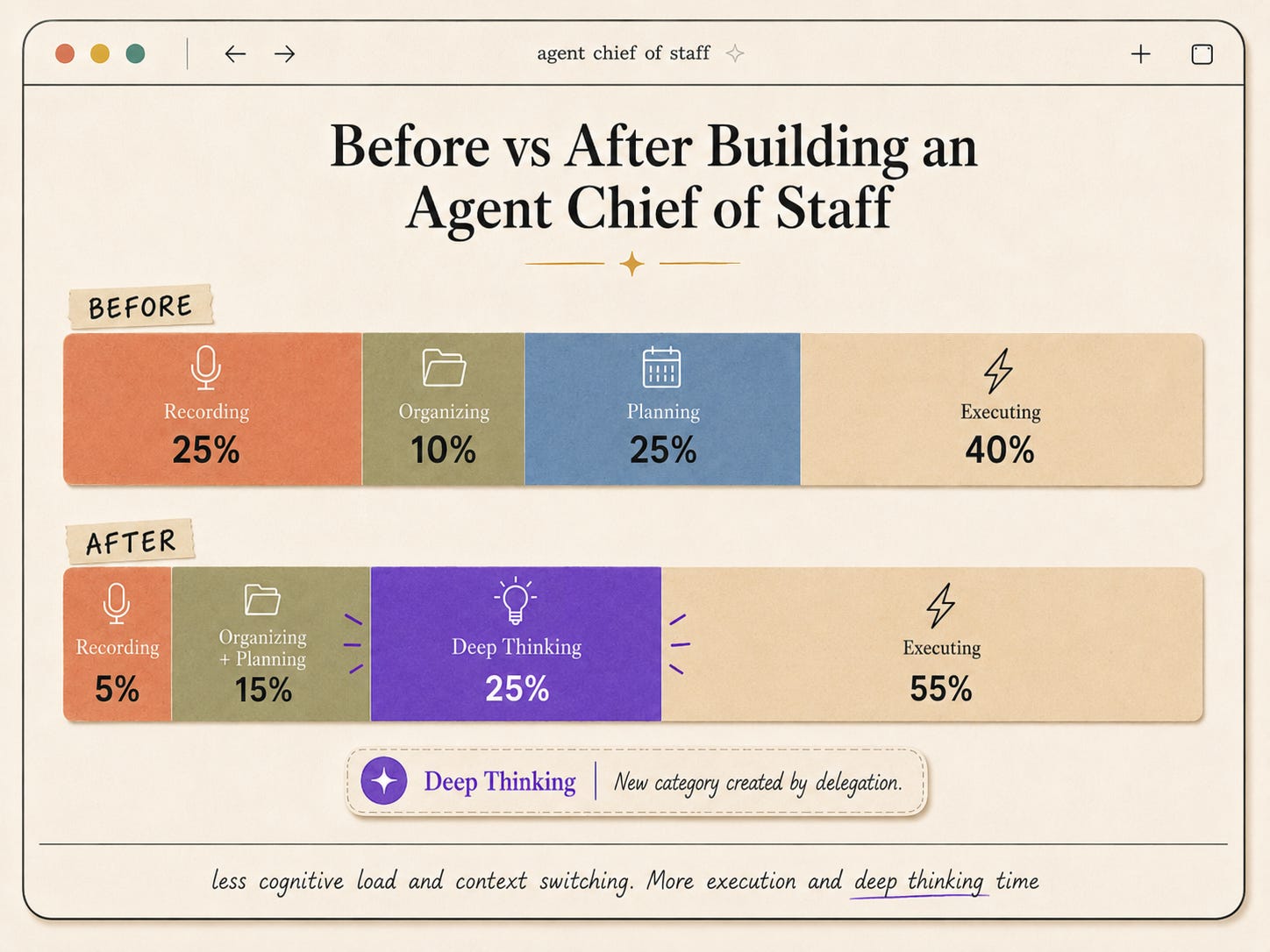
Now, My CoS runs most of that operating system for me. Most of the pre-work happens in conversation with it instead of inside my own crowded head. It knows that deep thinking and creative work gets the morning shift, and everything else is scheduled based on priority levels and urgency.
The percentages don’t capture the best part, which is that I’m no longer carrying the cognitive load of everything I need to remember and follow up on. That has done more for my day-to-day peace than any of the actual time saved.
(I would share a screenshot of my briefing but it’s long)
Here’s a peak into a random Tuesday:
5:30–6am - Wake up and hurkle durkle before starting my absurdly long morning routine. I’m way more present and way less panicked about figuring out the day because I already know it’s handled.
6:55am - Mac wakes itself up. My CoS’s cron fires at 7, and the brief is waiting in Telegram: what’s on the calendar, what’s going on in my inbox, what’s at the top of my reminders file, a draft schedule for the day already built around all of these things. It asks if I want to change anything before adding time blocks in my calendar.
7:15am - Admin and email first, because I’m a creature of habit. Whatever plan I had 15 minutes prior usually shifts once the inbox clears, and my CoS sees that shift too since it’s monitoring the situation (my inbox). We make updates to the calendar and take on the day together.
8am - Deep thinking hours: writing, digging into whatever needs digging into, working through saved bookmarks. If something random comes to mind, like booking flights for a trip to SF, I tell my CoS and it pulls options for me.
11am - While walking to the gym, I send a voice memo to ask my CoS to begin planning Ryan’s bday trip. I include research criteria, things to consider, etc. My CoS comes back with a planning brief with date and location options, cost per person, viable villas, sample itineraries. All before my last hip thrust.
1pm - P1 territory: design mockups, formulation research, or whatever needs priority attention. I’ll sometimes have my CoS dig into the same question in parallel so we can compare notes.
3pm - I need to prep for a call, so I ask my CoS to pull context on who I’m meeting with. It provides a summary of our last conversation, open questions, anything else I might need to know (like what they recently posted on LinkedIn). After the call, a Granola summary is saved under an .md file for the person, and any action items or tasks are added to my reminders.md file.
5pm - P2 territory: I book that flight I asked for it to research (still not comfortable having it handle this for me), poke at wedding odds and ends, or deal with the personal admin that somehow reproduces by the hour.
7:30pm - I tell My Agent to wrap up my day. It folds in anything new, summarizes what we ticked off, and helps set tomorrow’s priorities - mirroring the morning in about five minutes.
I hope this gave at least one person a more concrete sense of what these things can actually do - and if not, that’s okay, too 😭
My CoS is still in its infancy, so it’ll likely look wildly different in a month or two, especially given the rate of new tech and capabilities. If this was interesting and you want to see how the setup evolves, lmk and I’ll write the update!
And if you’re a more experienced builder who sees obvious ways to level up my current stack, please advise.
ooxxooXoXXx,
SK
A shortened list of what I tried before landing on Hermes:
- OpenClaw - Stopped after Anthropic cut off Claude subscriptions and a wave of CVEs I didn’t have the aptitude to debug.
- Lindy - Good starter EA, but more assistant than execution engine.
- Zo Computer - “my type on paper”, but ultimately too buggy and slow.
- Claude, using /remote-control. I’m on a budget pre-revenue, so i’m using open models via Openrouter instead of tokenmaxxing with Anthropic.