A couple of months ago, I decided to start a business in the CPG space - specifically, functional nutrition. Since I consume 3 full meals and 30+ pills a day, I assumed I knew a decent amount about food and nutrition science. Then, during an R&D meeting, I realized I could only go one layer deep on a question like “why are you targeting these macros”.

A trap I’ve fallen into in this age of information abundance is mistaking the collection of facts for real understanding. My imposter syndrome was quick to point out that mine was superficial at best.
I’d heard this quote just days before that meeting: “With the tools available to us today, there is nothing keeping you from being one of the 50 most knowledgeable people on a subject within a year.” Chris Sacca, on Dialectic.
He said it before the current LLM era, which made me think I could compress the timeline - especially since I’m not trying to become the next Andrew Huberman. So I asked Claude to build me the equivalent of a 101-level course, adapted to how I learn and focused on the parts most relevant to the business I’m building.
Before LLMs, my safe space was a rabbit hole consisting of every podcast on a topic, a stack of blogs, X and Reddit threads, and research papers that I pretended to understand. This is how I decided on every vitamin in my stack. But ask me why I take something and I’d be impressed if I could faithfully recall a compelling reason.
I’m good at collecting information, but when material is too technical to actually sit with, I flatten it into whatever version I can make sense of and it’s usually oversimplified and incomplete. And then of course, I forget it.
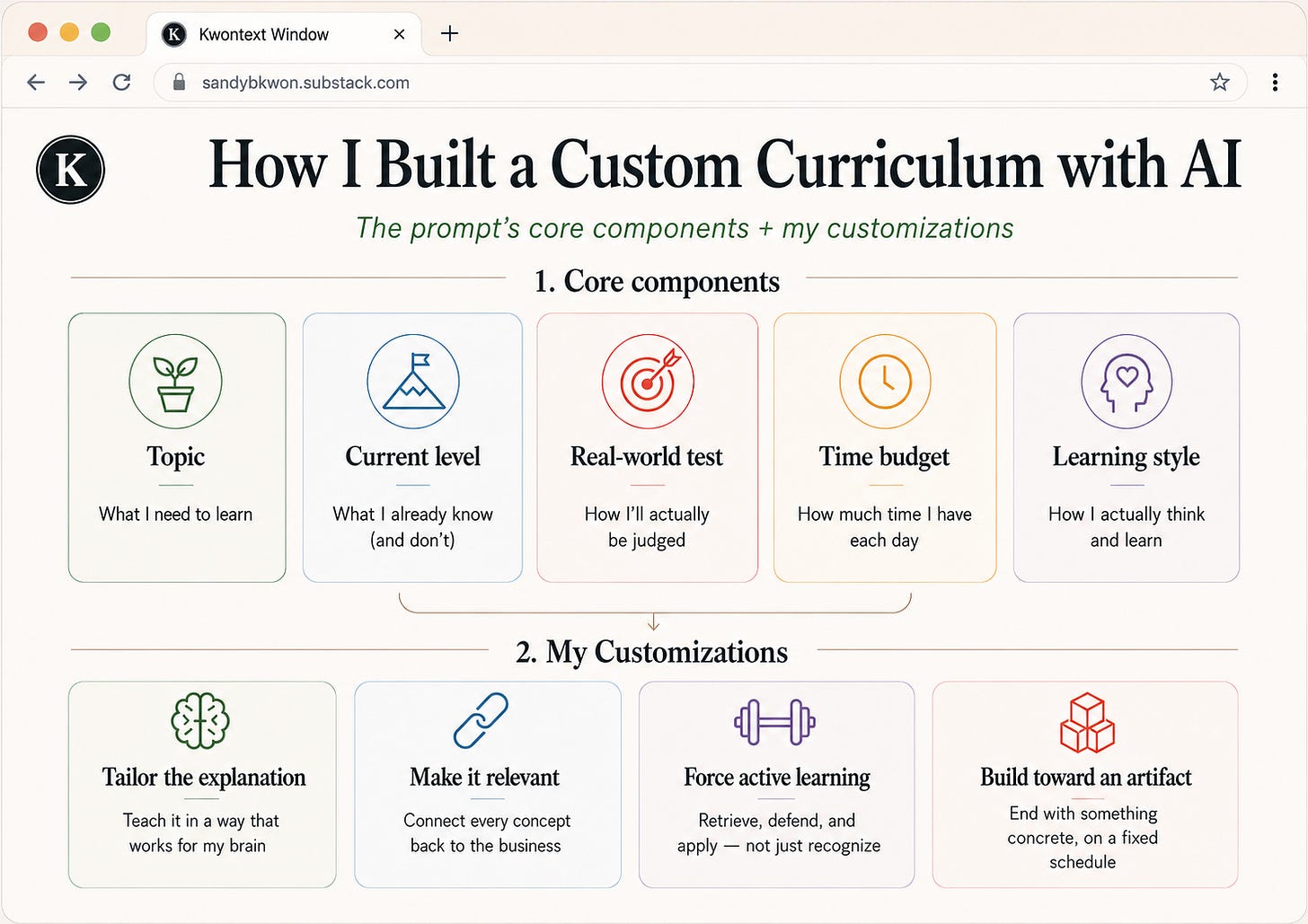
So building the curriculum required more than asking Claude to “teach me nutrition.” I needed the prompt to do two jobs: make the learning mechanics rigorous and make the material interesting enough that I would actually stick with it.
What I asked for came down to four things:
- Tailor every explanation to the way I think
- Connect every concept back to the business I’m building - this was the part that fueled interest
- Force me to retrieve, defend, and apply what I learn
- Build toward one concrete artifact
Claude already had a head start - thanks to my second brain and years of chat history - and what came back was a 14-day curriculum building toward a single capstone.
The curriculum-building and daily review prompts are both at the bottom.
Every day, Claude runs through the same six steps during my tutoring sessions:
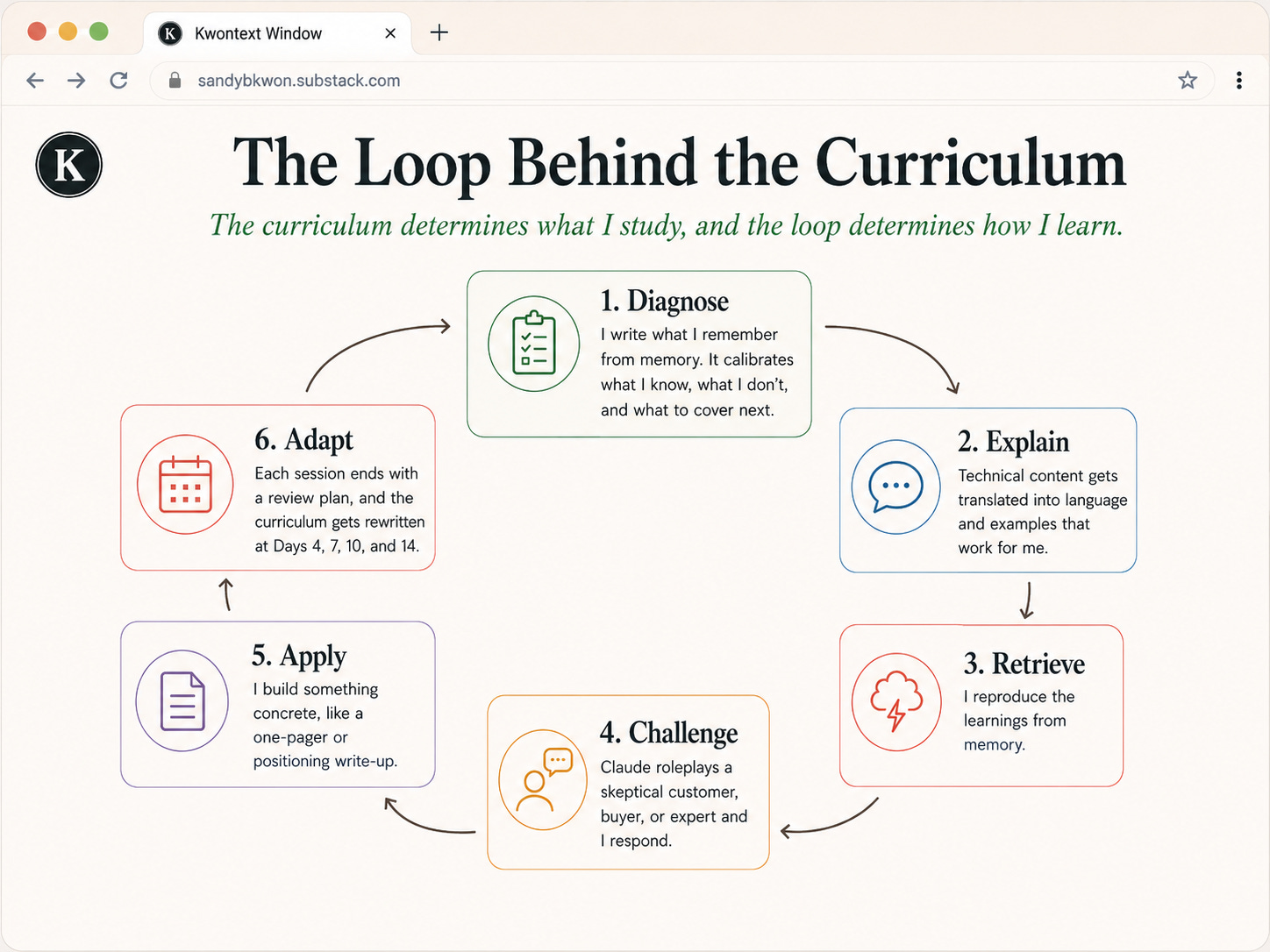
This loop is the part I couldn’t have designed myself, and it gives me some hope that I’m actually committing what I’m learning to memory.
Outside of that loop, I ask ChatGPT for second opinions, fact-checks, or to help reframe a concept when I hit a wall with Claude.
I’m a millennial, so my calendar governs my life. I currently have 2 scheduled blocks each day:
- A morning session, where I ask Claude to start things off and it tutors me on the day’s topics.
- A shorter retrieval session, set up as a routine task that fires off on its own each day. It’s closed-book, tests the day’s material, plus something from a few days back so I can’t just cram and forget.
Bless LLMs, because it’s truly a miracle that I look forward to my tutoring sessions each day (if only student Sandy had access to these tools to help her in grade school 😭). BUT, enjoying the process isn’t evidence that it’s working.
For my capstone, I’m building something for myself with what I’ve learned, all from memory. I’ll share my project in my next post after I fact-check everything so I’m not spreading fake news. Wish me luck!
ooxxooXoXXx,
SK
P.S. If you’ve built a similar program for yourself using AI, I’d love to hear how you designed it!
Here are the prompts I used - with placeholders so that you can adapt this to your specific goals and interests.
The prompt I used to build the curriculum:
The prompt I use every single day for the review session: